A Little Dog with a Very Long History
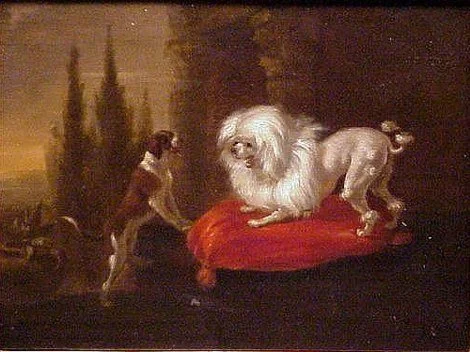
The Löwchen is one of the oldest breeds in existence, with evidence dating back to the 15th century. While Löwchen-like dogs appear scattered throughout art from the 1400s, the earliest well-documented depiction comes from Jan van Eyck's 1422 painting The Birth of the Baptist (see painting at right.) The expressive woodcuts of German artist Albrecht Dürer show Löwchen in the 16th century that are immediately recognizable — same conformation, same lion trim, same unmistakable personality — as the dogs we know today.
The breed's earliest recorded name was actually the Maltese Lion Dog. France has since claimed country of origin status, a distinction several other countries also contest. Several countries boldly defend their stake in the breed's origins, with theories placing its roots in the Mediterranean, Russia, and even Tibet. Whatever its true origin, the Löwchen has survived centuries of upheaval to emerge virtually unchanged.

The Birth of the Baptist, 1422.
Look for the Löwchen in the lower left corner!
Seen in the Courts of Europe
The historical trail of the Löwchen runs through the grandest courts of Europe. Fifteenth century tapestries already show a small companion dog groomed in the distinctive lion clip — long coat on the head, ears, neck and shoulders, clipped short behind. By the 17th century, when the ladies of the French nobility had developed a passion for small lap dogs, the Petit Chien Lion appeared regularly alongside Phalènes, Bichons and miniature Poodles in the paintings of the era.
The painting Le chien de Mme de Pompadour shows a black and white dog that scholars consider far closer to a Löwchen than a Poodle. Jean-Baptiste Huet's 1775 canvas Chien et Chat depicts a bicoloured dog with a visibly silky coat — again, unmistakably Löwchen. A lithograph depicting a meeting between Joséphine de Beauharnais and Napoleon almost certainly shows a Petit Chien Lion at her feet. Even a sketch by the great Spanish painter Goya appears to include one of these tiny dogs.
Perhaps the most poignant of these historical appearances is a painting by Antoine Duclaux completed in the summer of 1813. Queen Hortense de Beauharnais — daughter of Joséphine and stepdaughter of Napoleon — had just suffered the sudden loss of her closest friend and was staying in Aix-en-Savoie to recover from her grief. A young painter was commissioned to capture her portrait, and chose to paint her from behind, seated under a pergola, gazing out over a sweeping landscape. At her side, with small paws balanced on the bench, sits a little white dog — almost certainly a Löwchen — seemingly offering the grieving queen some quiet comfort. The viewer is left to wonder whether it was sorrow that turned her face away.
Both Buffon, who explicitly named the "Chien-lion" in his natural history and placed it in his taxonomic table of dog breeds, and Linnaeus, the celebrated naturalist, included the breed in their formal classifications — confirmation that by the 18th century the Löwchen was a recognized and documented breed, not a passing fancy.
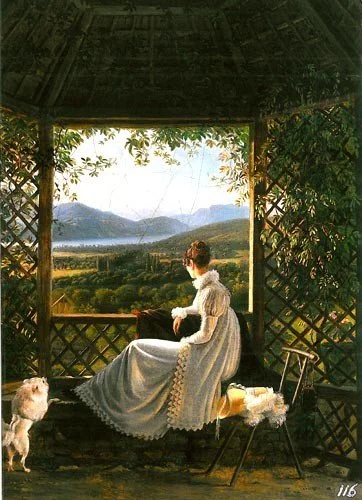
Queen Hortense de Beauharnais under a pergola, Antoine Duclaux, 1813.
Note the little Löwchen at her side.
The Legend of Bijou
Of all the stories that illuminate the Löwchen's character, none captures it more perfectly than the legend of Bijou.
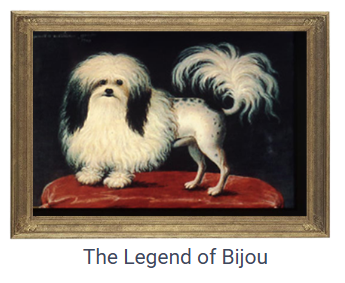
In the late 1700s, Bijou, a parti-coloured Löwchen, lived in a castle in Weilburg, Germany, perched high above the Lahn River. One day, unwilling to be left behind when his beloved master rode off to the hunt, Bijou leapt from a castle window sixty feet above the river below.
The ending of the story exists in two versions. One holds that Bijou survived the leap and was rewarded by riding to the hunt on his master's saddle — the place of honour. The other says the jump ended in tragedy. What is certain is that Bijou became famous throughout the region for his extraordinary devotion and fearlessness.
His life-size portrait, completed in 1787, still hangs today in the baroness's bedroom at Weilburg Castle — a permanent tribute to one small dog's lion heart. Those who know the breed today will recognise Bijou's spirit immediately. The devotion, loyalty and utter fearlessness that made him legendary are very much alive in the Löwchen of the 21st century.

The Lion Cut — Practical, Not Just Pretty
The Löwchen's trademark lion clip is one of the most recognizable and distinctive grooming styles in the dog world — but its origins were far more practical than decorative.
The most romantic explanation holds that ladies of the court would slip the dog's clipped hindquarters under the bedcovers to warm their cold feet, while the full mane and flowing coat attracted fleas away from the sleeper. A more pragmatic theory suggests it was simply a sanitary measure to prevent matting and infestation in an era before modern grooming products.
Whatever its true origin, the lion cut has remained the breed's signature for at least six centuries — appearing in tapestries, paintings and woodcuts from the 1400s right through to the show rings of today. It is required for dogs shown in conformation, but purely optional for companion Löwchens, who are just as charming in a tidy pet trim.
One thing is certain — whoever first decided to groom a small dog to resemble a lion had either a wonderful sense of humour, a very cold bedroom, or both.
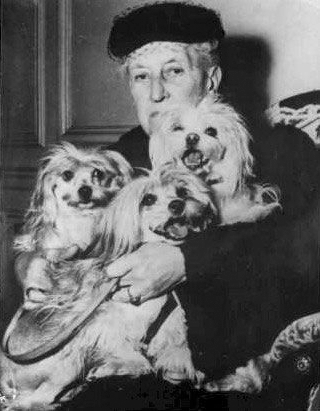
Saved from Extinction — Madame Bennert's Mission
By the time of World War II, the Löwchen had nearly vanished from the earth. The breed that had warmed the feet of empresses, inspired Renaissance artists and leapt fearlessly from castle windows was on the brink of disappearing forever.
It was a Belgian woman, Madame Madelaine Bennert, who refused to let that happen. Bennert had owned Löwchens since 1897, when she purchased her first dog from Maximillian de Conick — the first documented modern breeder and exhibitor of the breed. When the war left the Löwchen population devastated, she devoted herself to finding the last surviving dogs.
"After a long and disappointing search," she wrote, "I finally found two wonderful females. One was a blue and came from Lille, and the other was biscuit-coloured and came from the area of Dieghem. After a long search, I finally found a blue male, and this was the beginning of my small dog kennel."
From those three dogs, Madame Bennert rebuilt the breed. Working closely with German breeders for many years, she steadily increased Löwchen numbers while maintaining quality. The breed then passed into the care of German veterinarian Dr. Hans Rickert, whose kennel Von den Drei Löwen became the foundation from which every living Löwchen today descends.
English breeders began importing Löwchens in 1968. Three dogs from an English kennel arrived in the United States in 1971, imported by Charles and Jane Cook. Löwchen came to Canada in 1976, and the breed was officially recognized by the Canadian Kennel Club in 1995.